
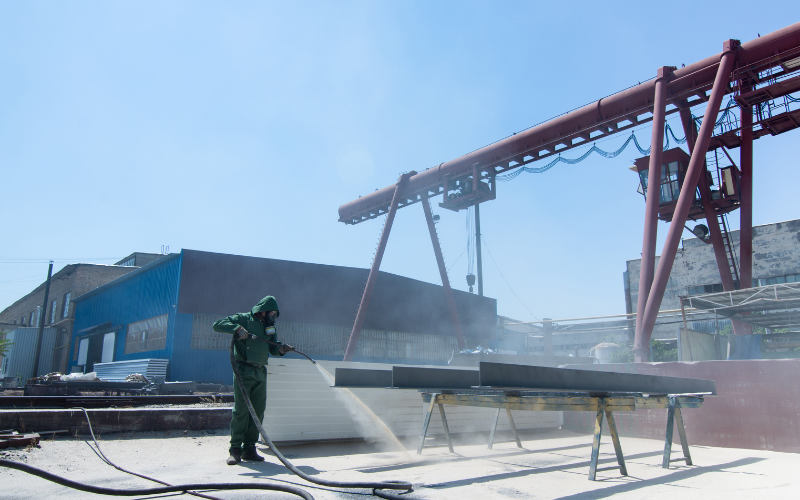
Facility managers ask us this question all the time, but it starts with a misconception: dry ice blasting and sandblasting are not two competing ways to do the same job. They are different processes designed for different purposes. Choosing between them is less about which method is “better” and more about what you need to accomplish without damaging the substrate, compromising a coating system, or creating unnecessary downtime.
The simplest way to understand the difference is this:
Sandblasting prepares a surface. Dry ice blasting cleans one.
Sandblasting uses an abrasive media to remove coatings, corrosion, scale, and other material while creating a surface profile for a new coating to bond to. Dry ice blasting uses solid CO₂ pellets to remove contaminants without leaving blasting media behind, making it particularly useful when you need to clean equipment, machinery, or sensitive surfaces without altering the underlying substrate.
That fundamental difference affects everything that matters to a facility manager: surface condition, coating performance, containment, cleanup, downtime, waste disposal, regulatory requirements, and total project cost. The right choice starts with understanding what you need the blasting process to do.
The Core Difference: Profile vs. Cleanliness
Abrasive blast cleaning propels engineered media at high velocity to strip rust, mill scale, and existing coatings while cutting a controlled anchor profile into the substrate. Protective coatings bond mechanically, and without the right depth and angularity, even a premium epoxy will disbond. Industry data has long held that the large majority of coating failures trace back to inadequate surface prep, not to the coating itself.
Dry ice blasting removes contaminants without touching the substrate. When the solid CO₂ pellets hit the surface at supersonic speed, three things happen at once. The pellets mechanically dislodge buildup, the thermal shock from -109°F media causes contaminants to contract and fracture off, and the CO₂ sublimates on impact, expanding into gas and lifting debris away from the surface.
No media stays behind and no moisture is introduced. No profile is created either, which is why dry ice blasting is the wrong choice ahead of a high-performance coating system, and why it is the right choice on a food-contact conveyor line.
When Sandblasting Is the Right Call
Abrasive blasting is the best choice when the surface needs to accept a new coating, or when contamination is bonded tightly enough that mechanical removal is the only practical way to get down to a sound substrate.
That covers much of the heavy industrial work: structural steel such as beams, columns, trusses, and framing headed for new construction or rehabilitation; tank and vessel interiors being prepared for a new liner; piping, weldments, and fabricated assemblies blasted to specification before shipment; and bridges, water towers, and elevated structures undergoing complete recoating programs.
Abrasive blasting is also the right choice when a written surface-preparation specification governs the project. SSPC, NACE, and AMPP standards establish measurable requirements for surface cleanliness and preparation, while coating manufacturers specify the surface condition their products require. If the coating system calls for a particular blast profile or a standard such as SSPC-SP10 near-white metal or SP5 white metal, the preparation method must be capable of meeting that specification. Dry ice blasting generally is not a substitute because it does not create the same abrasive surface profile.
One terminology clarification worth making is that modern industrial “sandblasting” rarely involves actual sand. Silica sand presents a serious respirable-silica hazard and is heavily restricted or prohibited for many blasting applications. Industrial contractors instead use media such as steel grit, garnet, aluminum oxide, glass bead, crushed glass, or other abrasives selected according to the substrate, contaminant, required surface profile, and coating specification.
The point is not that abrasive blasting is inherently better. It is that when the job requires surface preparation rather than simple cleaning, the abrasive process is doing something dry ice blasting is not designed to do.
When Dry Ice Blasting Is the Right Call
Reach for dry ice blasting when the substrate cannot tolerate abrasion, moisture is a liability, or the secondary waste created by conventional blasting would create a disposal or contamination problem.
- Food and beverage processing: Dry ice can remove protein buildup, grease, carbon, and product residue from conveyors, mixers, ovens, baking lines, packaging equipment, and smokehouses without introducing water or leaving behind a blasting medium. That can reduce disassembly and cleanup while helping facilities avoid the moisture-related problems that come with wet cleaning, including flash rust and conditions that can support microbial growth.
- Pharmaceutical manufacturing: Pharmaceutical manufacturing and controlled environments follow the same basic logic, but with even tighter contamination controls. Dry ice blasting can clean filling lines, processing equipment, and other machinery without introducing water or leaving abrasive media behind. Where controlling particles and cross-contamination is critical, eliminating secondary blasting media can be a significant advantage.
- Electrical equipment: Enclosures, transformers, switchgear, and control panels cannot be exposed to water or loose conductive media. Dry ice is non-conductive and does not introduce a liquid cleaning agent, making the process useful for cleaning electrical and industrial equipment where moisture and residue are unacceptable. Similar considerations make it valuable in energy and petrochemical facilities, where controlling ignition hazards and keeping equipment dry are priorities.
- Precision tooling: Injection molds, press dies, robotic cells, and printing equipment accumulate release agents, adhesive, ink, carbon, and other buildup that can affect product quality and equipment performance. Abrasive media can alter critical surfaces or dimensional tolerances, while chemical cleaning may require soaking, disassembly, and additional rinsing. Dry ice blasting removes the buildup without mechanically abrading the tool, allowing many components to be cleaned in place while preserving the surface geometry.
In these applications, the advantage of dry ice is not simply that it cleans well. It is that it removes contamination while leaving the underlying surface largely untouched and without creating another stream of blasting media that the facility has to collect, contain, and dispose of.
The Comparison Side by Side
| Factor | Industrial Sandblasting | Dry Ice Blasting |
| Creates anchor profile | Yes, controlled and measurable | No |
| Substrate impact | Abrasive by design | Non-abrasive |
| Moisture introduced | None (dry abrasive) | None |
| Secondary waste | Spent media plus removed debris | Removed debris only; CO₂ sublimates |
| Meets SSPC/NACE cleanliness standards | Yes, SP5 through SP18 | Not applicable |
| Equipment disassembly | Often required | Usually avoidable |
| Suited to food-contact surfaces | No | Yes |
| Safe on energized or sensitive electrical | No | Yes, subject to assessment |
| Typical use | Prep before coating or lining | Cleaning and decontamination |
Factors That Determine Which is Best
The choice between dry ice blasting and abrasive blasting usually comes down to a handful of practical questions. Before comparing equipment or pricing, look at what needs to happen to the asset, how much downtime you can absorb, and what the cleaning process leaves behind. These factors often make the right method clear before cost even enters the discussion.
- What happens to the surface next: If a coating or lining follows, you need a profile which calls for abrasive blasting. If the asset goes back into service as-is, dry ice is often the faster and cleaner path.
- Downtime tolerance: Dry ice work can frequently be done in place, sometimes on running equipment after a safety assessment. Abrasive blasting in an occupied facility involves containment, engineering controls, and a longer window. On a tight maintenance shutdown, that difference is the deciding factor more often than cost.
- Waste handling and containment: Spent abrasive must be collected and disposed of, and if lead-based coatings are involved, that becomes a regulated waste stream with OSHA and EPA requirements attached. Dry ice leaves only the contaminants you removed.
- Substrate sensitivity: Gaskets, seals, thin-gauge metal, rubber components, and delicate finishes do not survive abrasive media well.
- Regulatory environment: Food, pharma, and cleanroom facilities have cleaning requirements that rule out abrasives and chemicals before cost enters the conversation.
Sometimes the Answer Is Both
 On maintenance and restoration projects, dry ice blasting and abrasive blasting can work in sequence rather than in competition. Dry ice blasting can remove grease, oil, and process fouling before abrasive blasting takes over to remove corrosion and create the surface profile required by the coating system. That first cleaning step matters. Abrasive blasting through heavy oil or grease can drive contamination into the surface profile, creating adhesion problems that may not become apparent until the new coating begins to fail.
The harder part is determining the right process before the work begins. Substrate condition, exposure history, existing coatings, the new coating specification, and the facility’s operational constraints all influence the answer. A photograph can show you what a surface looks like, but it cannot tell you everything you need to know about what is underneath or what preparation the finished coating system requires.
That is why our estimators assess the asset before recommending a scope of work. Our in-house coatings inspectors work to NACE, SSPC, and AMPP standards, so the recommendation is based on the condition of the asset and the requirements of the coating system, not simply on whichever blasting method is most convenient for the job.
Get an Assessment for Your Facility
The right blasting method starts with the asset, not the equipment. Sometimes the job calls for abrasive blasting to remove corrosion and create the surface profile a coating system requires. Sometimes dry ice is the better choice for removing contamination without abrasion, moisture, or secondary media. On some maintenance projects, the best approach is to use both.
BlasTek has been blasting since 2013, and we still do the work every day. Our teams operate from our Shelbyville and Grand Rapids facilities, with mobile field crews serving customers throughout Michigan, Indiana, Ohio, and Southern Illinois.
If you are not sure whether industrial sandblasting services or industrial dry ice blasting services fit your application, let us evaluate the asset and recommend the right approach. Call 616-243-7550 or fill out our contact form to schedule an on-site assessment across Grand Rapids, MI, Northern Indiana, Southern Illinois,Three Rivers, MI, Kalamazoo, MI, Ohio and Southwest and Northern Michigan.
Dry Ice Blasting vs Sandblasting FAQs
Can dry ice blasting replace sandblasting before painting?
No. Dry ice blasting does not create the anchor profile that protective coatings need to bond mechanically to a substrate. It can remove grease, oil, and loose or flaking coatings, which makes it useful as a first step, but abrasive blasting to the specified SSPC or NACE standard is still required before a coating system goes on.
Is dry ice blasting more expensive than sandblasting?
Per hour of nozzle time, dry ice blasting usually costs more, largely because of CO₂ consumption. Total project cost often tells a different story. Dry ice avoids media purchase and disposal, frequently eliminates disassembly and reassembly labor, and reduces containment requirements and downtime. Which method is cheaper depends on the specific asset and scope.
Which method is safer for my workers and my facility?
Both are safe when executed correctly, and both require controls. Abrasive blasting demands respiratory protection, containment, and dust suppression. Dry ice blasting eliminates airborne abrasive and silica exposure but requires ventilation and CO₂ monitoring in confined spaces, since CO₂ displaces oxygen as it sublimates.
Can either method remove lead paint?
Abrasive blasting is the standard approach for lead abatement, performed inside engineered containment with the engineering controls and waste handling that OSHA and EPA require. Dry ice blasting can remove some coatings, but lead removal still generates hazardous waste that must be captured and disposed of properly. Either way, this is regulated work that needs a certified abatement contractor.
Do you offer both services on the same project?
Yes. Sequencing dry ice cleaning ahead of abrasive blasting is common on maintenance and restoration work, and running both through one contractor keeps the scope, schedule, and inspection under a single point of accountability.