
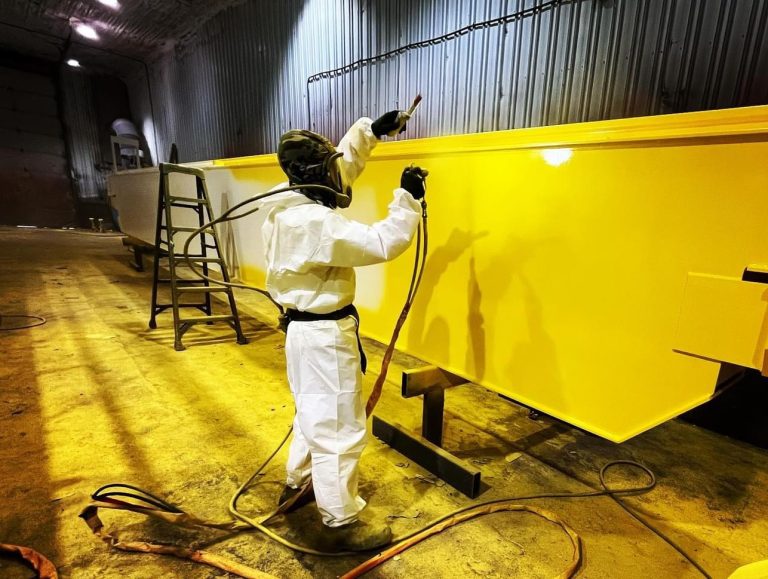
Most coating failures don’t start with the paint. They start months earlier, when someone compares the price per gallon of two products that were never designed for the same job.
Industrial coating isn’t a single product. It’s a system: a primer, one or more intermediate coats, and a topcoat, each applied at a specified dry film thickness and each serving a different purpose. Change one layer to save a few dollars, and you change the performance of the entire system. That’s how a tank exterior designed to last 15 years can start bleeding rust at the weld seams in three.
Before that cheaper substitution makes its way onto a purchase order, here’s how to evaluate an industrial coating system properly.
Start With the Service Environment, Not the Product
The most useful question is not “what paint should we use.” It is “what is this surface going to live through.”
Manufacturers build systems around exposure categories, and those categories drive everything downstream. Work through your asset honestly:
- Atmospheric exposure: Steel exposed to Michigan freeze-thaw cycles, road salt spray, and industrial fallout faces a different problem than steel in a heated warehouse.
- Immersion or intermittent immersion: Constant contact with water, wastewater, or process fluid demands a lining, not a paint job, plus inspection to confirm the film is pinhole-free.
- Chemical exposure: Acids, caustics, solvents, and fuels each attack different resin chemistries. A coating that shrugs off sulfuric acid may soften in solvent contact.
- Temperature: Insulated piping, exhaust stacks, and dryer housings need systems rated for continuous service temperature, not just ambient cure.
- Abrasion and impact: Loading docks, chutes, hoppers, and equipment frames take mechanical punishment that has nothing to do with corrosion.
- Sanitation and air quality: Food, beverage, pharmaceutical, and cleanroom facilities add requirements for washdown resistance, low VOC, and sometimes food-contact certification.
Most assets fall into more than one category. A clarifier has an immersed interior, a splash zone, and a UV-exposed exterior. That is three specs on one structure and treating it as one is how owners end up recoating early.
Match the System to the Substrate
Carbon steel is the most common industrial substrate and, in many ways, the most straightforward: blast to the specified profile, prime, build the system, and apply the topcoat. Galvanized steel is more demanding because its zinc surface can reject many primers. It may require a compatible tie coat or a light sweep blast to create the mechanical profile needed for adhesion. Stainless steel and aluminum require non-ferrous blasting media to avoid embedding steel particles that can later develop into rust spots.
Concrete is a different discipline altogether. Moisture vapor transmission, laitance, and surface pH can all affect coating adhesion. If a concrete floor has an active moisture drive beneath the slab, even a properly specified coating can eventually disbond in sheets. The substrate has to be evaluated and prepared for the coating system, not the other way around.
Surface Preparation Decides Whether Any of It Works
You can specify a premium three-coat system, pay for premium labor, and still watch it fail if the prep was wrong. Manufacturers publish a required surface prep standard for every product, and it is not a suggestion.
BlasTek works to SSPC and NACE standards from SP-1 solvent cleaning through SP-5 white metal blast. The right one depends on the coating and the environment; an immersion lining typically calls for white or near-white metal, while a maintenance recoat on interior structural steel may only need commercial blast or a power tool clean.
Anchor profile matters just as much as cleanliness. Too shallow and the coating has nothing to grip. Too aggressive and high peaks push through the film, leaving pinpoint rusting. Media selection controls that profile, which is why we keep aluminum oxide, garnet, steel shot, glass bead, crushed glass, soda, walnut shell, and corn cob on hand rather than blasting everything with the same grit.
Where the Common Systems Fit
The four coating families below cover a large share of industrial applications. Understanding what each one is designed to do makes it easier to build the right system and much easier to have a useful specification conversation.
- Zinc-rich primers protect steel through galvanic action; the zinc corrodes preferentially, helping protect the underlying steel. Inorganic zinc silicate and organic zinc epoxy are common primer choices for structural steel, bridges, and exposed infrastructure where corrosion protection is the priority.
- High-build epoxies do much of the heavy lifting in the middle of the system. They provide strong adhesion, chemical resistance, moisture-barrier performance, and the ability to build the required film thickness efficiently. The tradeoff is UV stability. Left exposed outdoors, epoxy will chalk and fade over time. That is primarily a cosmetic issue, but it can still come as a surprise to an owner expecting the finish to retain its original appearance.
- Aliphatic polyurethane topcoats address that UV limitation. They provide better color and gloss retention, which is why they are commonly used as the finish coat on water towers, tanks, bridges, and other exposed structures where appearance matters years after application.
- Specialty linings are reserved for the more demanding environments. Vinyl esters, novolac epoxies, and other chemical-resistant immersion systems are designed for applications such as tank interiors, secondary containment, and process equipment where standard epoxy systems may not provide adequate resistance. These systems also tend to be less forgiving of surface preparation, ambient conditions, mixing, application, and cure schedules.
Field or Shop Changes the Spec
Where the work happens is part of the coating system, not simply a logistics decision.
- Shop application gives you greater control over temperature, humidity, lighting, and cleanliness. Overspray can be contained, surfaces can be rotated for more consistent coverage, and application conditions can be monitored throughout the process. For structural steel packages, tanks, vessels, and high-volume components, shop application often produces a more consistent film at a lower cost per square foot.
- Field application is unavoidable when you are coating existing infrastructure, but it introduces variables that must be accounted for in the specification. Dew point and substrate temperature, wind, containment, access, and the operating schedule of the facility can all affect when and how a coating can be applied. A plant may not be willing or able to shut down simply to accommodate your coating schedule, and some products have application windows that are difficult or impossible to meet outdoors during a West Michigan winter.
Those constraints are much easier to solve during specification than after the coating crew arrives. The right system has to work not only on the substrate, but also in the environment where it will be applied.
Compare Cost Per Year, Not Cost Per Gallon
The cheapest system on bid day is rarely the cheapest system over the life of the asset.
Instead of comparing material prices alone, run the numbers against the expected recoat cycle. A system that costs 30% more upfront but lasts twice as long can deliver a lower total cost of ownership. The reason is simple: the expensive part of recoating is rarely the paint itself. It is the containment, access equipment, surface preparation, labor, waste disposal, and production time that come with doing the work again.
That is why our estimators conduct on-site assessments before preparing a quote. Substrate condition, environmental exposure, operating constraints, and the available maintenance budget all factor into the recommendation. The goal is not to specify the cheapest system, it is to select a coating system that makes sense for the asset’s expected service life and maintenance plan.
Before You Write the Spec, Answer These Questions
- What is the substrate, and what condition is it in right now?
- What exposures does each area of the asset see?
- What service life do you need before the next planned recoat?
- Is there an existing coating, and is it sound, failing, or lead-containing?
- Can the work be done in a shop, or does it have to happen in place?
- Who owns the specification: your engineer, the manufacturer’s rep, or your contractor?
Talk Through Your Coating Specification with BlasTek
BlasTek has been blasting and coating industrial assets since 2013, and our in-house coatings inspectors work to NACE, SSPC, and AMPP standards on every project. We apply systems from Sherwin-Williams, Tnemec, International, and Carboline, and we can execute an owner-supplied or engineer-supplied specification or build a recommendation from your service environment.
Learn more about our industrial painting services. Call at 616-243-7550 or fill out our contact form to schedule an on-site assessment across Grand Rapids, MI, Northern Indiana, Southern Illinois, Three Rivers, MI, Kalamazoo, MI, Ohio and Southwest and Northern Michigan. Bring us the asset and the environment. We will help you get the system right the first time.
Industrial Paint Systems FAQs
What is an industrial paint system?
An industrial paint system is a multi-layer coating assembly, typically a primer, one or more intermediate build coats, and a topcoat, applied at specified dry film thicknesses over a surface prepared to a defined standard. Each layer performs a distinct function: corrosion protection, film build and chemical resistance, and UV or abrasion resistance. Because the layers are engineered to work together, substituting one product changes the performance of the whole system.
How do I know whether I need epoxy or urethane?
In most cases you need both. Epoxy provides adhesion, film build, and chemical and moisture resistance but is not UV stable, so it works as a primer or intermediate coat. Aliphatic urethane provides UV resistance, gloss retention, and color stability, which makes it the topcoat for exterior assets. Interior assets with no UV exposure often do not need a urethane finish at all.
How long should an industrial coating system last?
Service life depends on exposure, the system specified, and the quality of surface preparation. A properly specified and applied system on atmospheric structural steel can perform for well over a decade before maintenance recoating, while immersion and chemical service environments run shorter cycles. Prep is usually the deciding factor in whether a system reaches its expected life.
Can BlasTek work from a specification our engineer already wrote?
Yes. BlasTek regularly executes owner-supplied and engineer-supplied coating specifications, and we coordinate with coating manufacturers’ technical representatives to confirm compliance when required. If a specification is not yet written, our estimators can develop a recommendation based on substrate condition, service environment, and performance requirements.