
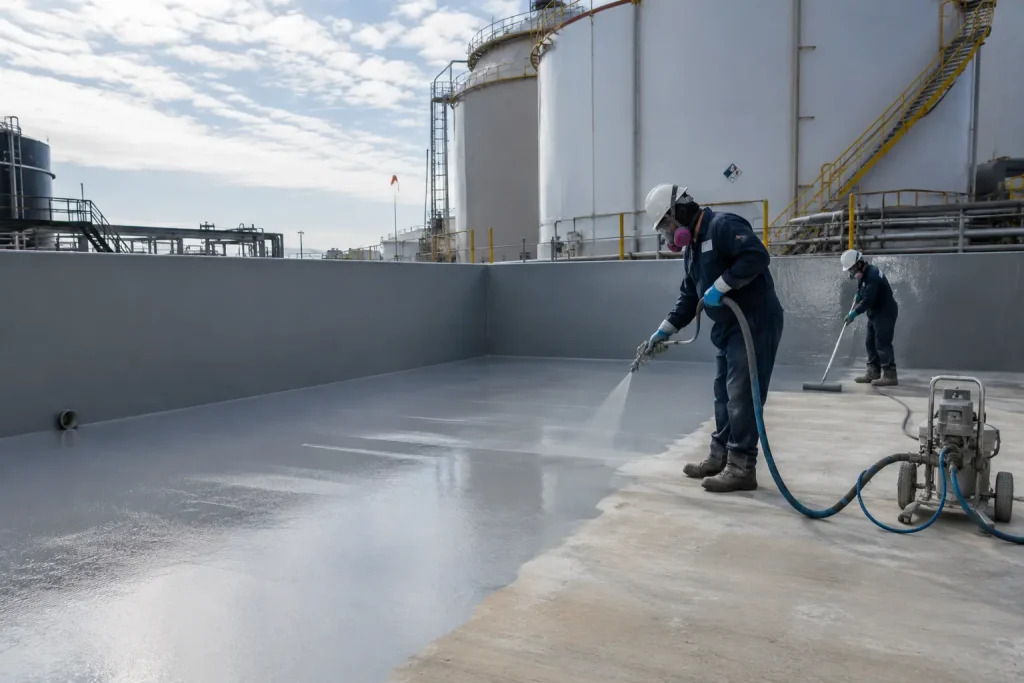
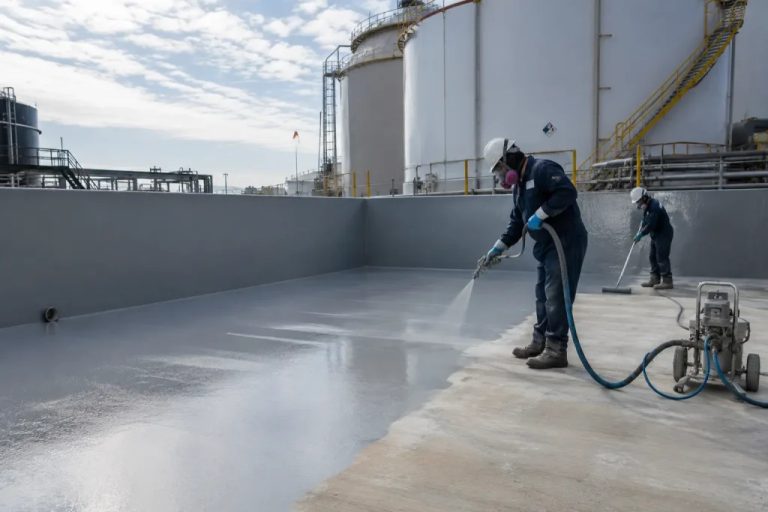
A secondary containment structure has one job, to hold what escapes when the primary vessel fails. A tank ruptures, a valve lets go, a drum tips over during a transfer, and the bund, dike, or pit underneath is supposed to catch every gallon before it reaches the soil, the storm drain, or the groundwater.
Here is the part that gets overlooked. That containment structure is almost always concrete, and concrete is not impermeable to the products most facilities store. Petroleum, solvents, acids, and caustics soak into bare concrete, work through hairline cracks, and reach the substrate below. The dike wall you are counting on can be doing very little to contain a spill.
That is why the coating matters, and why chemical resistance is the property that decides whether the coating does its job or fails at the worst possible moment. A containment lining that cannot stand up to the exact product sitting above it is not a barrier, it is a delay.
What Secondary Containment Protects Against
Secondary containment is a physical barrier system built to capture the contents of a primary storage vessel, a tank, drum, pipeline, or process vessel, when that vessel leaks, overflows, or fails outright. For above-ground storage tanks, that usually means a concrete or steel dike sized to hold the full volume of the largest tank plus freeboard for rainfall. The structure only works if it stays impermeable. It has to resist chemical attack from the stored product and hold the liquid long enough for cleanup, with no seepage into the ground. Uncoated concrete does not clear that bar for most petroleum products and chemicals, and even well-built containment develops cracks and permeability as it ages, freezes, thaws, and takes on chemical exposure year after year. When we talk about a containment coating, we are not talking about a cosmetic finish or a floor sealer. We are talking about the component that turns a concrete pit into a functional impermeable barrier. Get the coating wrong and the rest of the structure is doing far less than the compliance paperwork says it is.Chemical Resistance is Where Containment Coatings Live or Die
Every coating has a chemistry, and every chemistry has limits. A system that shrugs off diesel fuel can blister and soften under a concentrated acid. A lining that handles dilute alkalis fine can break down when a solvent it was never rated for pools against it for hours. The stored product does not care what the coating was marketed as. It reacts with whatever it touches. This is why matching the coating to the actual chemical exposure is the entire game. Not the general category of “chemicals.” The specific products, concentrations, and temperatures that coating will see if the primary vessel lets go. A containment lining that is under-specified for its service will fail exactly when it is needed, and a failed containment coating is worse than no coating at all, because it looks like protection right up until the spill proves it isn’t. That failure carries real consequences. Contaminants can reach stormwater systems, groundwater, and nearby sensitive environments. Cleanup costs climb into serious money, regulators get involved, and the facility that thought it was compliant discovers its containment was never rated for the product it was holding.Matching the System to the Exposure
There is no single containment coating that is right for every facility, and any contractor telling you otherwise is selling what they have on the shelf. BlasTek specifies from a range of systems and selects based on the chemical exposure, service conditions, and performance requirements in front of us:- High-build epoxy: For general containment where the exposure is petroleum products, alkalis, dilute acids, and water, high-build epoxy is often the right call. It delivers strong resistance across a wide range of chemicals at an economical cost for large containment areas. We apply solvent-based and high-solids epoxy systems from Sherwin-Williams, Tnemec, and Carboline, building film thickness of 20 to 40 mils over prepared concrete for reliable performance.
- Vinyl ester: When the exposure gets aggressive from strong acids, oxidizers, and concentrated solvents, epoxy hits its ceiling. Vinyl esters resist the chemical species that attack and degrade epoxy, which makes them the specification of choice for chemical process facilities, pharmaceutical plants, and any operation with concentrated chemical exposure.
- Polyurea and polyurethane: For containment areas that move, outdoor structures cycling through Michigan temperature swings, or bunds with irregular geometry, spray-applied linings offer a seamless, flexible barrier that bridges minor cracks and joint movement. On structures where a brush and roller system would struggle, a spray-applied seamless lining simply performs better.
The Coating is Only as Good as the Prep Underneath It
Here is something worth being blunt about: most containment coating failures do not start with the coating. They start with the concrete. Coating failure in containment structures is most often traced to improper surface preparation, trapped moisture, residual laitance, or cracks and joints that never got addressed. You can apply the perfect chemical-resistant system over a poorly prepared slab and it will still delaminate, blister, or peel, and the chemical resistance you paid for never gets the chance to do its job. We handle this at the front end. Before any coating goes down, we run a comprehensive concrete evaluation that includes moisture testing, identifying cracks and joints, assessing surface contamination, and selecting the preparation method, whether that is shot blasting, scarifying, or acid etching, that fits the coating system and the substrate condition. Every crack and construction joint gets routed, cleaned, and filled with elastomeric sealant or epoxy mortar before coating, so there are no leak paths hiding under a fresh lining. At containment walls, floor-to-wall transitions, and the high-stress intersections where linings tend to fail first, we embed reinforcing fabric into the base coat to strengthen those critical areas. Details like these are the difference between a containment system that holds for 15 years and one that fails an inspection in three.Chemical Resistance and Compliance Go Together
None of this sits outside the regulatory picture. Facilities that store or handle petroleum products, chemicals, and other hazardous materials above threshold quantities are working under EPA Spill Prevention, Control, and Countermeasure (SPCC) rules, EPA Resource Conservation and Recovery Act (RCRA) requirements, and applicable state environmental regulations. A containment coating that is not chemically resistant to the stored product is not just a technical problem, it is a compliance exposure. If the barrier cannot hold the product it is rated to contain, the containment does not meet its intent, no matter what the drawings say. We specify and install our containment systems to meet these regulatory requirements, and we provide documentation of materials, application, and inspection for your compliance records. When the auditor asks, the paperwork is there.Secondary Containment Coating from BlasTek
Secondary containment is one of those systems nobody thinks about until it is tested, and by then it is too late to wish it had been specified correctly. Chemical resistance is not an upgrade or a nice-to-have. It is the property that determines whether your containment contains anything at all. BlasTek has been doing surface prep and protective coatings the right way since 2013, and we approach containment the same way we approach every project: assess the substrate, understand the exposure, and specify the system that fits. Our in-house coatings inspectors work to NACE, SSPC, and AMPP standards on every job. If you’re not certain your containment coating is rated for what you store, that uncertainty is worth resolving before a spill resolves it for you. Learn more about BlasTek’s secondary containment coating services, fill out our online assessment request form to get started today, or call us at (616) 243-7550 to have our team assess your containment structure, evaluate your chemical exposure, and recommend the right lining system for your facility.Secondary Containment Coating FAQs
Does concrete secondary containment really need a chemical-resistant coating?
Yes. Uncoated concrete is permeable to petroleum products and many chemicals, which means a bare concrete dike or bund can allow the stored product to absorb into the structure and eventually reach the soil and groundwater below. A properly specified chemical-resistant coating creates the impermeable barrier that lets the containment contain a spill, and it supports EPA and state environmental requirements.
How do I know which containment coating my facility needs?
It comes down to the specific product you store, its concentration and temperature, and the service conditions of the containment area. General petroleum and dilute chemical exposure is often well served by high-build epoxy, aggressive acids and solvents call for vinyl ester, and structures with movement or irregular geometry may need a flexible polyurea or polyurethane lining. BlasTek assesses your exposure and substrate before recommending a system rather than applying a one-size-fits-all product.
What happens if a containment coating isn’t rated for the chemical it’s holding?
The coating can soften, blister, or break down when the product it wasn’t rated for pools against it, which lets the spill reach the concrete and potentially the environment. A failed containment coating is worse than an obvious problem because it looks like protection until a spill proves it isn’t, exposing the facility to cleanup costs and compliance violations.
How long does a properly applied containment coating last?
Service life depends on chemical exposure, UV exposure, temperature cycling, substrate preparation, and application quality. Properly applied epoxy containment systems typically deliver 10 to 20 years in moderate environments, while aggressive chemical applications may require specialty systems and more frequent maintenance.
Can containment structures be coated while the facility stays operational?
In many cases, yes. BlasTek evaluates site conditions, safety requirements, and access limitations to build a project plan that minimizes disruption while maintaining coating performance and compliance requirements.