
Old brick and stone don’t get a second chance. Once an aggressive cleaning process eats into the face of a hundred-year-old façade, that surface is gone, and no amount of sealer or tuckpointing brings it back. That is the hard part of cleaning historic masonry: the paint, soot, and decades of grime you want removed sit on a material that is often softer and more fragile than the coating covering it.
Soda blasting handles that problem by doing less. Instead of cutting into the substrate, it lifts what sits on top and leaves the material underneath alone. For restoration crews, architects, and building owners working on older brick, limestone, sandstone, and masonry, that difference is the whole point.
Why Historic Masonry is Easy to Ruin
Most historic brick has a hard outer layer, sometimes called the fire skin, formed when the brick was fired. That layer is denser and more weather-resistant than the softer clay inside it. Cut stone develops its own weathered surface over decades. Lime-based mortar, common in older buildings, is intentionally soft so it can flex and let moisture escape. High-pressure sandblasting treats all of that as one problem to grind away. It strips the fire skin off brick, opens the pores, and exposes the soft interior to water. Once water gets in, freeze-thaw cycles do the rest, and you end up with spalling, crumbling faces, and mortar joints that wash out years earlier than they should have. The damage often does not show up right away, which is what makes it so costly. A building can look cleaner the day the work finishes and start failing a few winters later. This is exactly why preservation guidance has warned against harsh abrasive cleaning of historic masonry for decades. The Secretary of the Interior’s Standards and National Park Service preservation briefs both push toward the gentlest method that will do the job. Soda blasting fits that thinking because it removes contamination without profiling or reshaping the surface beneath it.How Soda Blasting Works
Soda blasting propels sodium bicarbonate, the same compound as baking soda, in specially graded crystals at low pressure. When a crystal hits the surface, it fractures and releases enough energy to lift paint, soot, carbon, and grime, then breaks down into a fine powder. You get a clean surface without the cutting action of sand or grit. The number that matters here is hardness. Sodium bicarbonate sits at roughly 2.5 on the Mohs hardness scale, which makes it soft enough to strip a coating while leaving brick, stone, and mortar essentially undisturbed. It cleans without creating an anchor profile, so dimensions, tooling marks, and the original finish stay intact. The media is also water-soluble, non-sparking, non-toxic, and biodegradable, which makes it a sensible choice around occupied buildings, wood framing, and environmentally sensitive sites. Compare that to a standard abrasive like garnet or aluminum oxide, which is chosen specifically because it cuts and roughens a surface. That is the right tool when you need a profile for a new coating on structural steel. It is the wrong tool for a limestone cornice you are trying to preserve.Where it Fits on Brick, Stone, and Masonry
Soda blasting earns its place on restoration jobs where the goal is to clean or strip without altering the material. On historic surfaces, that covers a lot of common work:- Old paint and coatings: Strips paint from brick and stone without gouging the face.
- Fire and smoke damage: Cuts through soot, carbon, and smoke residue after fire damage, one of the more frequent reasons a historic building needs cleaning in the first place.
- Graffiti removal: Lifts graffiti off brick, stone, and concrete without etching the substrate underneath.
- Grime and biological staining: Cleans general atmospheric grime and biological staining while preserving carved detail, tooled brick, and the profile of the mortar joints.
What Soda Blasting Will Not Do
BlasTek’s approach is to match the method to the substrate, not to sell one process for every job, so it is worth being clear about the limits. Soda blasting is not aggressive, which is its strength on historic surfaces and its weakness elsewhere. It does not efficiently remove heavy rust or mill scale, and it does not create the anchor profile that high-performance coating systems need for adhesion. If a masonry project includes structural steel that needs recoating, that steel usually needs an abrasive step, often grit blasting, either instead of or as a follow-up to soda cleaning. Residue is the other consideration on masonry. Sodium bicarbonate is water-soluble, but leftover soda must be rinsed and neutralized properly, because residue left in porous brick or stone can lead to efflorescence and salt staining down the line. On a preservation job, rinsing and cleanup are part of the process, not an afterthought. This is one of the reasons the on-site assessment matters; the right pressure, the right media grade, and the right cleanup plan all depend on the specific surface in front of the crew.On-Site Work with Containment
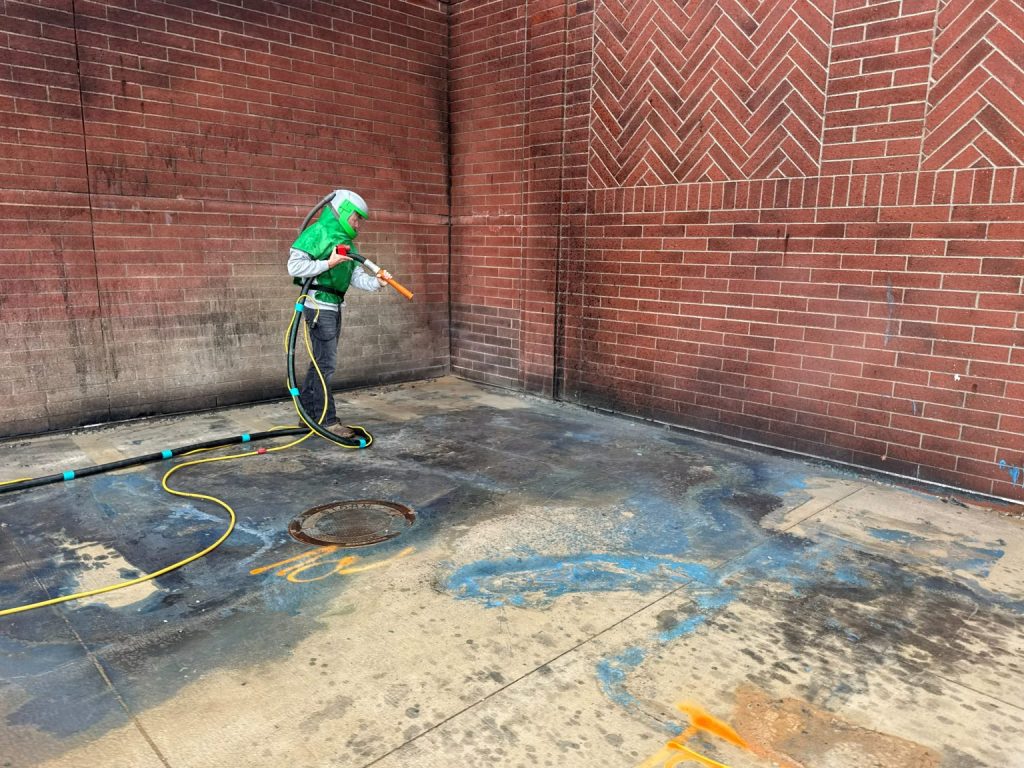
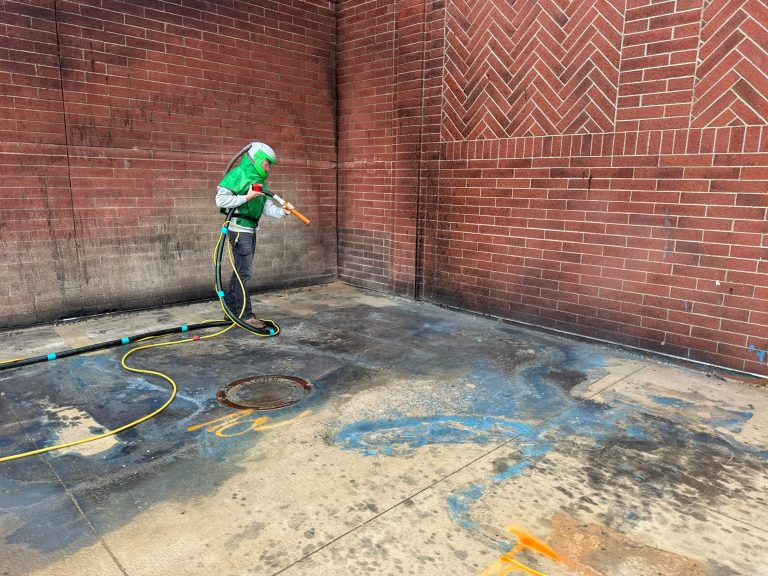
Most historic masonry can’t come to a shop. A façade, a chimney, a storefront cornice, or an interior brick wall has to be cleaned in place. For fixed assets like these, BlasTek deploys portable soda blasting equipment and engineered containment directly to the site. That keeps the media and removed contaminants contained, protects the surrounding property and landscaping, and lets the work happen around an occupied or operating building when needed. For smaller components that can be removed, such as detached ornamental pieces or salvaged elements, the Shelbyville and Grand Rapids shops offer a controlled environment with material handling for cleaning parts before reinstallation.Blast to Specification, Not Appearance
The temptation on any cleaning job is to reach for the most aggressive method because it works fastest. On a modern steel structure, that logic often holds. On a nineteenth-century brick building, it is how irreplaceable surfaces get destroyed. BlasTek has provided specification-driven surface preparation and cleaning across the Midwest since 2013, and the process starts the same way every time; evaluate the substrate, understand what needs to come off, and choose the media and pressure that clean it without harming what stays. For historic brick, stone, and masonry, soda blasting is frequently the answer, because the whole point of restoration is to keep the original material, not grind it away.Talk to BlasTek About Your Restoration Project
If you’re planning work on historic brick, stone, or masonry and want it cleaned without the damage that comes from aggressive methods, BlasTek can help you specify the right approach. Our team evaluates your substrate and contamination, recommends the correct media and process, and provides a detailed estimate before any work begins. Fill out our online assessment request form to get started today, or call us at (616) 243-7550 to learn more about our soda blasting services.Soda Blasting for Historic Masonry FAQs
Is soda blasting safe for historic brick and stone?
Yes. Sodium bicarbonate is a soft blast media at roughly 2.5 on the Mohs hardness scale, so it removes paint, soot, and grime without cutting into or profiling the surface beneath it. That makes it well suited to historic brick, stone, and masonry, where preserving the original material is the goal.
Will soda blasting damage mortar joints?
Because soda blasting cleans without an aggressive cutting action, it is far gentler on soft lime-based mortar than high-pressure sandblasting. Pressure and media grade are matched to the surface during an assessment to protect the joints while still removing contamination.
Does soda blasting remove paint from brick and stone?
Yes. Soda blasting strips paint, primers, and coatings from delicate substrates without warping or gouging them, which is why it is a common choice for removing old paint and graffiti from historic masonry.
Can soda blasting be done on-site for a building?
Absolutely. BlasTek performs mobile soda blasting throughout the Midwest using portable equipment and engineered containment, which is the standard approach for fixed assets like façades, chimneys, and interior masonry that cannot be moved to a shop.
Is leftover soda residue a problem on masonry?
Sodium bicarbonate is water-soluble, but any residue must be rinsed away properly, since leftover soda in porous brick or stone can contribute to efflorescence and salt staining. Rinsing and cleanup are part of the process on restoration work.