Secondary Containment Coating Services — Protecting Your Facility and the Environment
Ensure regulatory compliance and safeguard against environmental contamination with BlasTek’s secondary containment coating services. We install high-build, chemically resistant lining systems in concrete bunds, pits, dike floors, and other containment structures to create a seamless, impermeable barrier that protects your facility, your workforce, and the surrounding environment from hazardous spills and leaks. Secondary containment is not only a regulatory requirement for facilities that store or handle petroleum products, chemicals, and other hazardous materials above threshold quantities, it is a critical layer of operational risk management. Any failure in containment can allow contaminants to reach stormwater systems, groundwater, or nearby sensitive environments. BlasTek’s containment coatings are engineered to deliver the chemical resistance, impermeability, and long-term durability these high-risk applications demand.What Is Secondary Containment?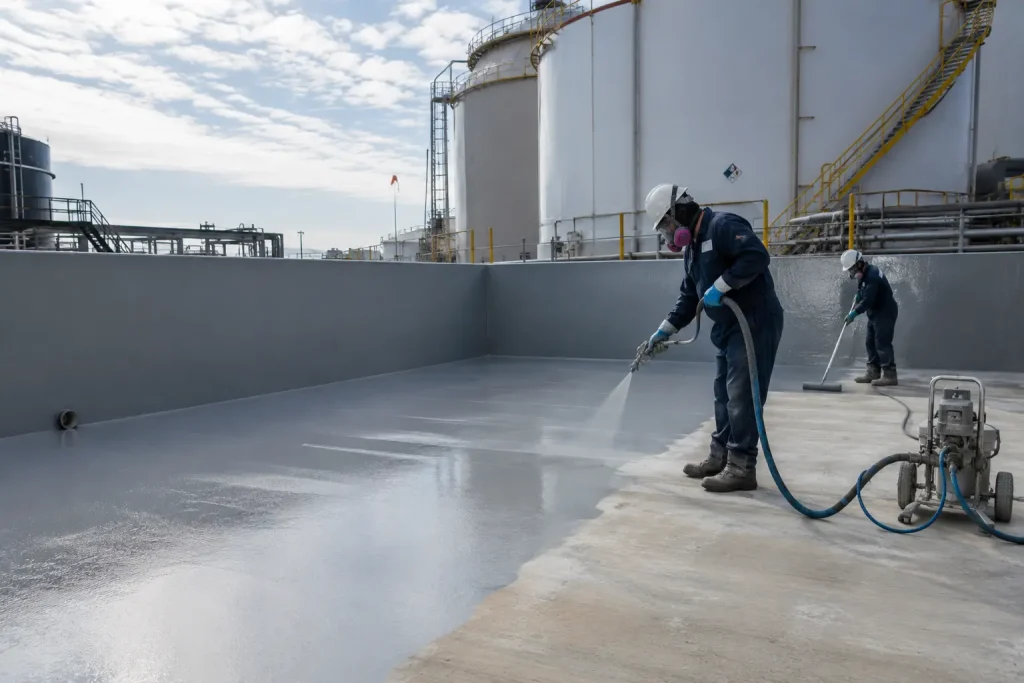
Secondary containment is a physical barrier system designed to capture the contents of a primary storage vessel such as a tank, drum, pipeline, or process vessel in the event of a leak, overflow, or catastrophic failure. For above-ground storage tanks, secondary containment typically consists of a concrete or steel dike or bund that surrounds the tank and has sufficient capacity to hold the full contents of the largest tank plus additional freeboard for rainfall.
The containment structure itself must be impermeable, able to resist the chemical attack of the stored product and retain liquids without seepage into the soil or groundwater below. Uncoated concrete is not impermeable to most petroleum products and chemicals, and even well-constructed concrete containment structures develop cracks and permeability over time. A properly specified and applied containment coating system is essential to maintaining the functional integrity of the secondary containment.
Secondary Containment Coating Systems
BlasTek offers a range of secondary containment coating systems engineered to match the specific chemical exposure, service conditions, and performance requirements of each facility. From cost-effective epoxy systems for general containment to high-performance vinyl esters and flexible polyurea linings for more demanding environments, each solution is selected to deliver long-term protection, regulatory compliance, and reliable containment performance.Epoxy Coating Systems for Chemical Containment
High-build epoxy systems provide excellent resistance to a wide range of chemicals including petroleum products, alkalis, dilute acids, and water, at an economical cost for large containment areas. BlasTek applies solvent-based and high-solids epoxy systems from Sherwin-Williams, Tnemec, and Carboline, providing film builds of 20 to 40 mils over prepared concrete for reliable containment performance.Vinyl Ester Linings for Aggressive Chemical Exposure
BlasTek applies vinyl ester lining systems for containment areas subject to strong acids, oxidizers, solvents, or other aggressive chemicals that exceed the resistance range of epoxy. Vinyl esters provide outstanding resistance to the chemical species that attack epoxy systems, making them the specification of choice for chemical process facilities, pharmaceutical plants, and operations with concentrated chemical exposure.Polyurea and Polyurethane Linings
Polyurea and polyurethane spray-applied linings provide seamless, flexible containment coatings that bridge minor cracks and joint movement in concrete containment structures. These systems are particularly valuable for outdoor containment areas subject to thermal cycling and for structures with irregular geometry where a spray-applied seamless lining is more effective than a brush and roller system.Concrete Surface Preparation for Containment Coatings
Coating failure in containment structures is most often traced to improper concrete surface preparation that results in trapped moisture, residual laitance, or untreated cracks and joints that compromise adhesion. BlasTek addresses these risks at the outset with a comprehensive concrete evaluation, including moisture testing, identification of cracks and joints, assessment of surface contamination, and selection of the appropriate preparation method such as shot blasting, scarifying, or acid etching, based on the coating system and substrate condition. All cracks and construction joints are routed, cleaned, and properly filled with elastomeric sealants or epoxy mortars prior to coating application, eliminating potential leak paths. At containment walls, floor-to-wall transitions, and areas subject to the highest stress, reinforcing fabric is embedded into the base coat to strengthen these critical intersections and prevent premature lining failure.Regulatory Compliance for Secondary Containment
BlasTek understands the regulatory framework governing secondary containment, including EPA Spill Prevention, Control, and Countermeasure (SPCC) regulations, EPA Resource Conservation and Recovery Act (RCRA) requirements, and applicable state environmental agency regulations. Our containment coating systems are specified and installed to meet these regulatory requirements, and we provide documentation of materials, application, and inspection for your compliance records.Request a Containment Coating Assessment
Contact BlasTek to assess your secondary containment structure and recommend an appropriate lining system. We will evaluate your containment design, chemical exposure, substrate condition, and regulatory requirements to specify the right solution. Call us at 616-243-7550 or fill out our contact form to get started.Frequently Asked Questions — Secondary Containment
Does secondary containment need to be coated if it is made of concrete?
Yes. Uncoated concrete is permeable to petroleum products and many chemicals. A properly applied secondary containment coating creates an impermeable barrier that helps prevent chemical absorption and supports EPA and state environmental containment requirements.
How long do secondary containment coatings last?
The service life of a containment coating depends on chemical exposure, UV exposure, temperature changes, substrate preparation, and application quality. Properly applied epoxy containment systems can typically provide 10 to 20 years of service in moderate environments, while aggressive chemical applications may require specialty systems and more frequent maintenance.
Can secondary containment structures be coated while they are in service?
In some cases, containment coating projects can be completed while a facility remains operational. BlasTek evaluates site conditions, safety requirements, and access limitations to develop a project plan that minimizes disruption while maintaining coating performance and compliance requirements.