Dustless Blasting Services — Surface Preparation Without the Dust
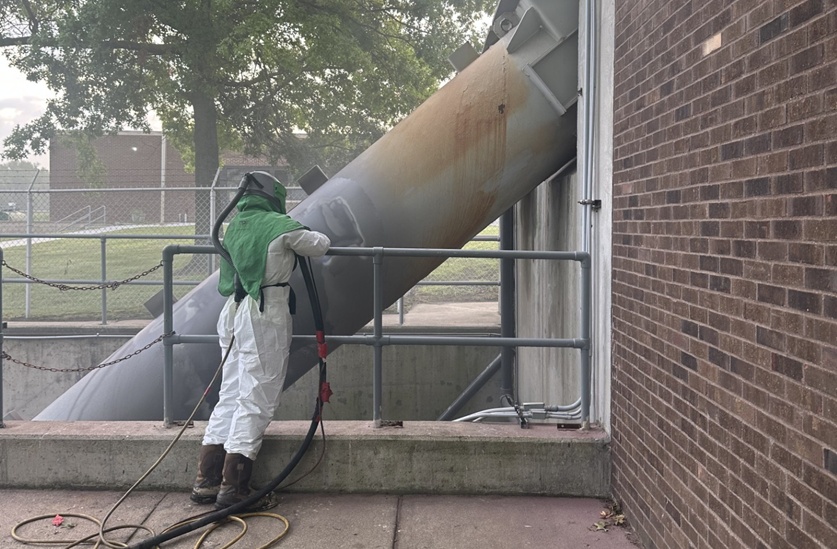 BlasTek’s mobile dustless blasting services help minimize downtime and environmental impact. As the evolution of traditional sandblasting, this wet abrasive blasting process uses water at the nozzle to suppress dust at the source, reducing airborne particles by up to 95%. The result is a cleaner, safer work environment that significantly limits exposure to harmful dust for both workers and building occupants, while making surface preparation possible in areas where open-air abrasive blasting is restricted or impractical.
Dustless blasting combines the proven performance of conventional abrasive blasting with advanced water injection technology that encapsulates abrasive media and blast debris before it becomes airborne. This allows us to achieve the same SSPC surface preparation standards as dry blasting, effectively removing rust, failed coatings, mill scale, and surface contaminants while producing the anchor profile required for long-term coating adhesion.
Because the process dramatically reduces dust, projects often require less containment and cleanup, helping reduce costs and downtime while improving overall efficiency. When working with steel substrates, rust inhibitors can also be applied to help prevent flash rust, all while remaining fully compatible with manufacturer coating specifications.
How Dustless Blasting Works
Dustless blasting equipment mixes abrasive media and water inside the blast pot before delivery to the blast nozzle. The wet slurry exits the nozzle at high velocity and impacts the surface with the same energy as dry blasting, but the water encapsulates the debris particles as they rebound, preventing them from becoming airborne dust. The wet slurry and removed contaminants fall to a work surface below, where they can be collected and disposed of.
Modern dustless blasting systems can also incorporate chemical rust inhibitors in the blast water, which prevent flash rust formation on the freshly blasted steel surface. This is a significant advantage in high-humidity field conditions where dry blasted steel can begin to oxidize within minutes, potentially requiring reblast before coating application. With inhibitor-enhanced dustless blasting, the work window between blasting and coating application is extended, giving applicators more flexibility in field conditions.
When Is Dustless Blasting the Right Choice?
 Dustless blasting is typically the best option for the following:
- Urban and populated areas where dust from dry blasting would affect neighboring properties, businesses, or residents.
- Near waterways or environmentally sensitive areas where dry blast debris could contaminate stormwater or surface water.
- Inside occupied facilities where dust generation would contaminate production areas or create safety hazards.
- Near electrical equipment where dry blast media could cause short circuits or equipment damage.
- On sensitive substrates or delicate surfaces where the softened impact of wet blasting is preferred.
- Projects with lead paint where dust suppression is a key element of the lead compliance control plan.
- Rapid project turnaround where reduced cleanup time is a priority.
Dustless Blasting Applications
By significantly reducing airborne dust and debris, dustless blasting makes it possible to complete high-performance surface preparation work in locations where traditional dry blasting would be disruptive, restricted, or impractical. This process delivers SSPC-compliant results while maintaining cleaner job sites and minimizing impact on surrounding areas.
Building Restoration
BlasTek’s dustless blasting service is particularly well-suited for building restoration projects in commercial, urban, and suburban settings where conventional dry blasting would create unacceptable dust and debris impact on surrounding properties. Dustless blasting prepares metal building components, masonry, and structural steel for restoration coatings without generating the dust clouds associated with dry blast operations.
Bridge and Structure Maintenance
Bridge maintenance and steel structure recoating projects often occur above occupied public right-of-ways, over water, or adjacent to environmentally sensitive areas. Dustless blasting provides the surface preparation performance required by bridge coating specifications while managing the dust and debris generation that makes conventional dry blasting difficult or impossible in these environments.
Tank and Vessel Field Preparation
Dustless blasting is effective for field preparation of tanks, vessels, and piping in industrial facilities where dust from conventional blasting would contaminate production areas or require extensive cleanup. The wet blast slurry falls close to the substrate, minimizing spread, and can be collected and disposed of more easily than dry blast media.
Dustless vs. Dry Blasting — Performance Comparison
A common question is whether dustless blasting achieves the same surface quality as dry blasting. When properly executed with appropriate media and blast parameters, dustless blasting achieves equivalent SSPC surface preparation standards, including SP-6 commercial blast and SP-10 near-white blast. The anchor profile depth and surface cleanliness are comparable, and the addition of rust inhibitor in the blast water often results in a better prepared surface in humid field conditions than unprotected dry blasting.
Get a Dustless Blasting Quote
Contact BlasTek to find out if dustless blasting is the right solution for your project. Our field services team will evaluate your site conditions, applicable dust restrictions, and surface preparation requirements to recommend the best approach. Call us at 616-243-7550 or fill out our contact form to get started.